
CGH FREE LEARNING · EDUCATOR & MEDIA PACK
Small investigations.
Useful discoveries.
Three free browser activities, paired with practical teaching prompts and honest model limits. For educators, families, librarians and editorial reviewers.
No account or purchase needed for these experiences. Suggested activities are editorial teaching ideas, not claims of classroom validation or learning gains.
Upper elementary observation; secondary geometry extension
Sun and Shadows: Change One Thing
Change time, season, latitude and pole height to connect sunlight geometry with shadow length and direction. The display uses local solar time rather than clock time.
Open the free experience →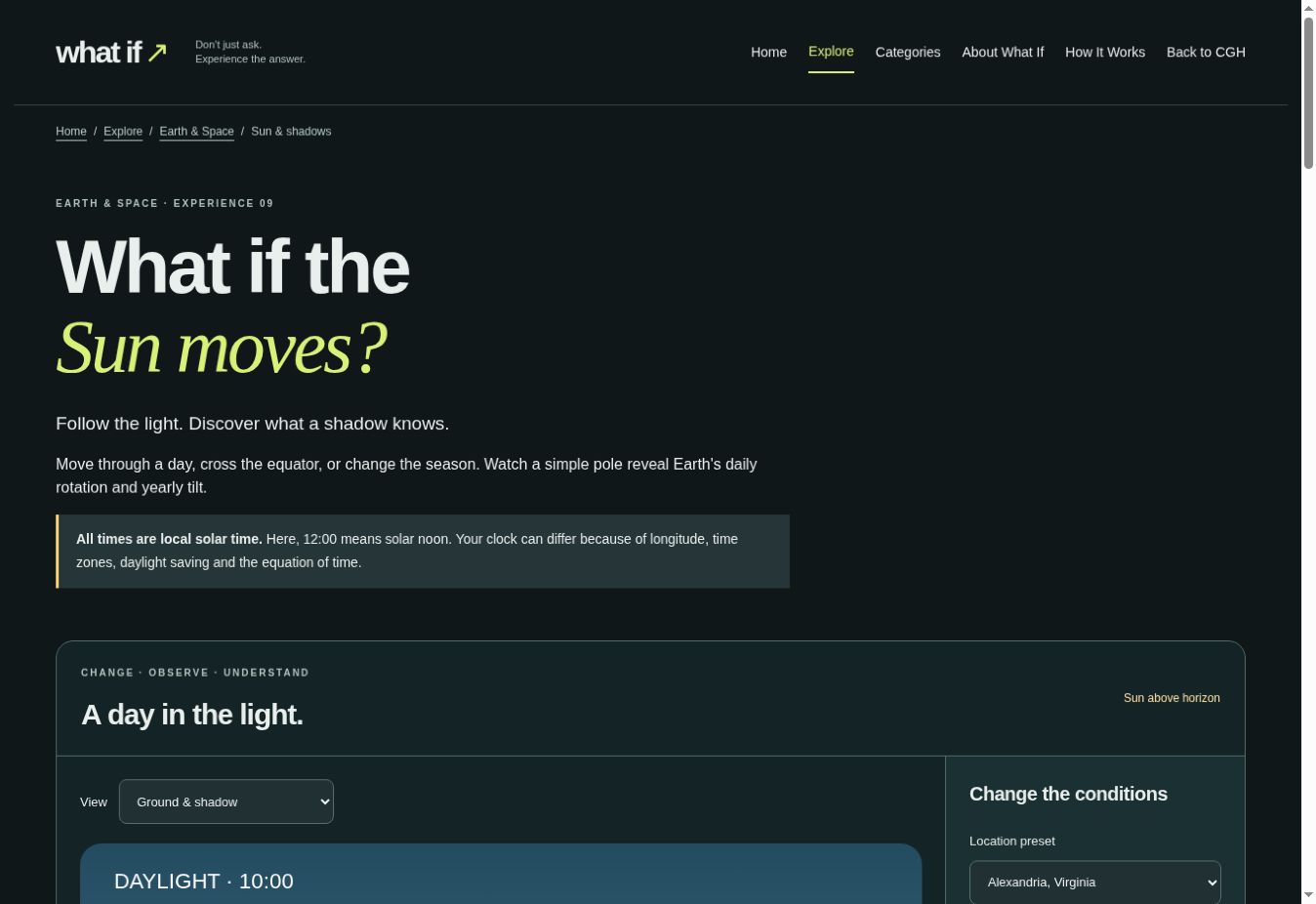
Try it with learners
A suggested 15-minute investigation for families, science clubs or classrooms; not a classroom-tested lesson.
- Keep the date and latitude fixed. Predict whether a taller pole makes a longer shadow.
- Record the default 6 ft pole and approximately 3.4 ft shadow at 10:00 solar time. Choose a prediction, then use Double pole height.
- Record the 12 ft pole and approximately 6.8 ft shadow. Explain what stayed fixed.
- Reset, compare June and December at the same latitude and solar noon. Explain how hemisphere changes your prediction.
Answer and discussion notes
At fixed positive solar elevation, shadow length is proportional to pole height: L = h / tan(elevation). Doubling h doubles L. Seasonal comparisons require holding latitude and solar time fixed.
Model limits: Illustrative geometry on level ground. Omits terrain, buildings, atmospheric refraction and twilight. Not a sunrise forecast or surveying tool. Never look directly at the Sun.
Middle school ratios; secondary introductory mechanics
Bicycle Gears: Ratio Without Extra Energy
Compare front and rear sprocket tooth counts to see wheel rotations, distance per pedal turn and the ideal torque trade-off. Guided steps, an activity and a text explanation support different ways to explore.
Open the free experience →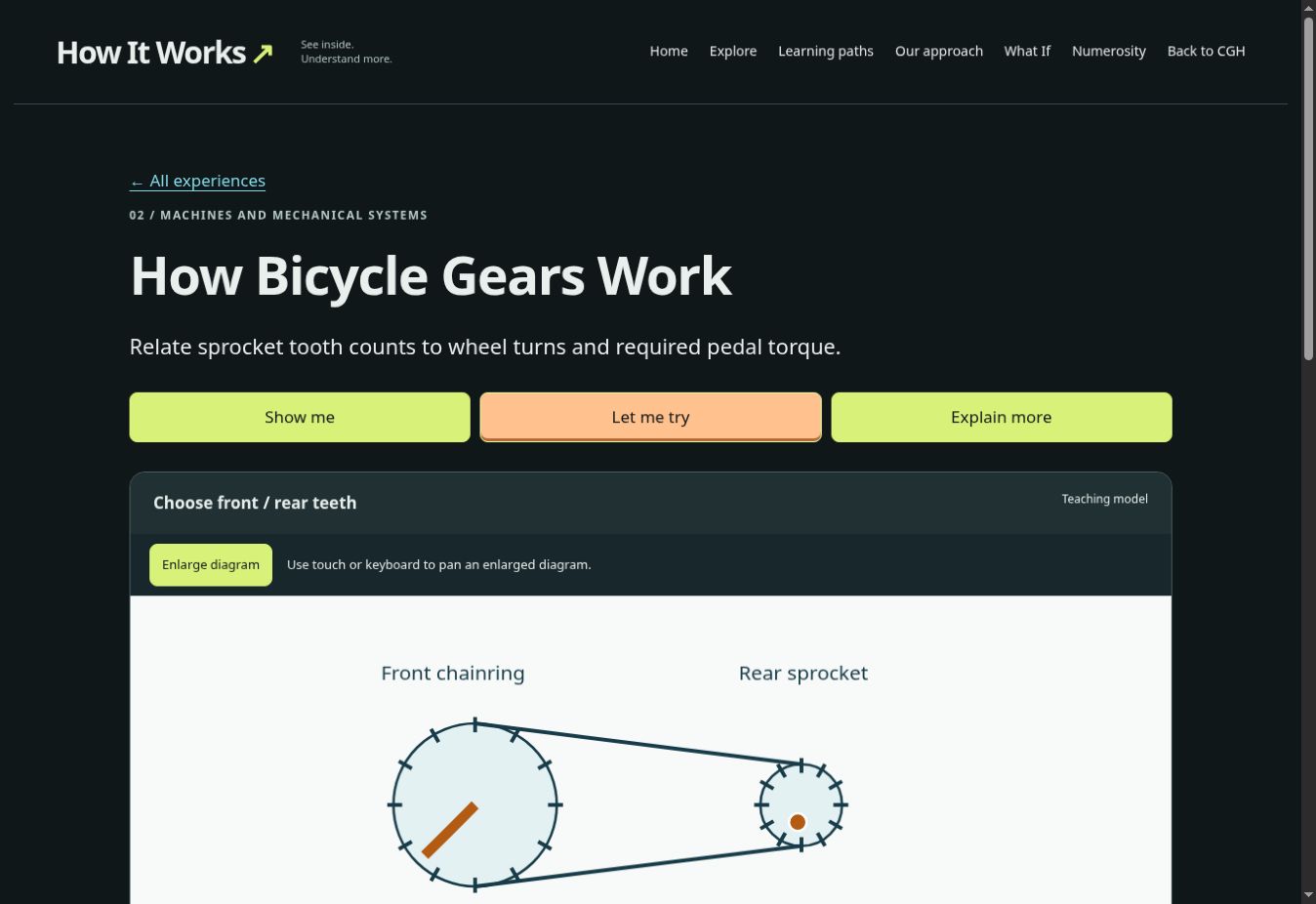
Try it with learners
A suggested 15-minute ratio investigation; no bicycle or riding required.
- Choose Let me try. Begin with 30 / 30 teeth. Predict wheel turns for one pedal turn.
- Select 40 / 20. Record wheel turns, distance and wheel rpm.
- Select 50 / 10. Calculate the expected ratio before reading the display.
- Discuss why travelling farther per pedal turn does not mean that gears create energy.
Answer and discussion notes
Front teeth / rear teeth gives 1, 2 and 5 wheel turns per pedal turn. With the stated 2.1 m circumference, distances are 2.1, 4.2 and 10.5 m. At 60 pedal rpm, wheel speeds are 60, 120 and 300 rpm. Ideal input torque for a fixed output wheel torque grows with this ratio.
Model limits: Ideal chain drive; fixed wheel circumference and cadence; no friction, slopes or tire slip. Schematic illustrations. Not cycling performance or safety advice.
Elementary fraction learners; older learners reviewing foundations
Fractions: Same Whole, Different Names
Connect an eight-part visual model with equivalent fractions and percentages, then open Adding fractions for a worked example, hints and numeric practice. No learner account is needed.
Open the free experience →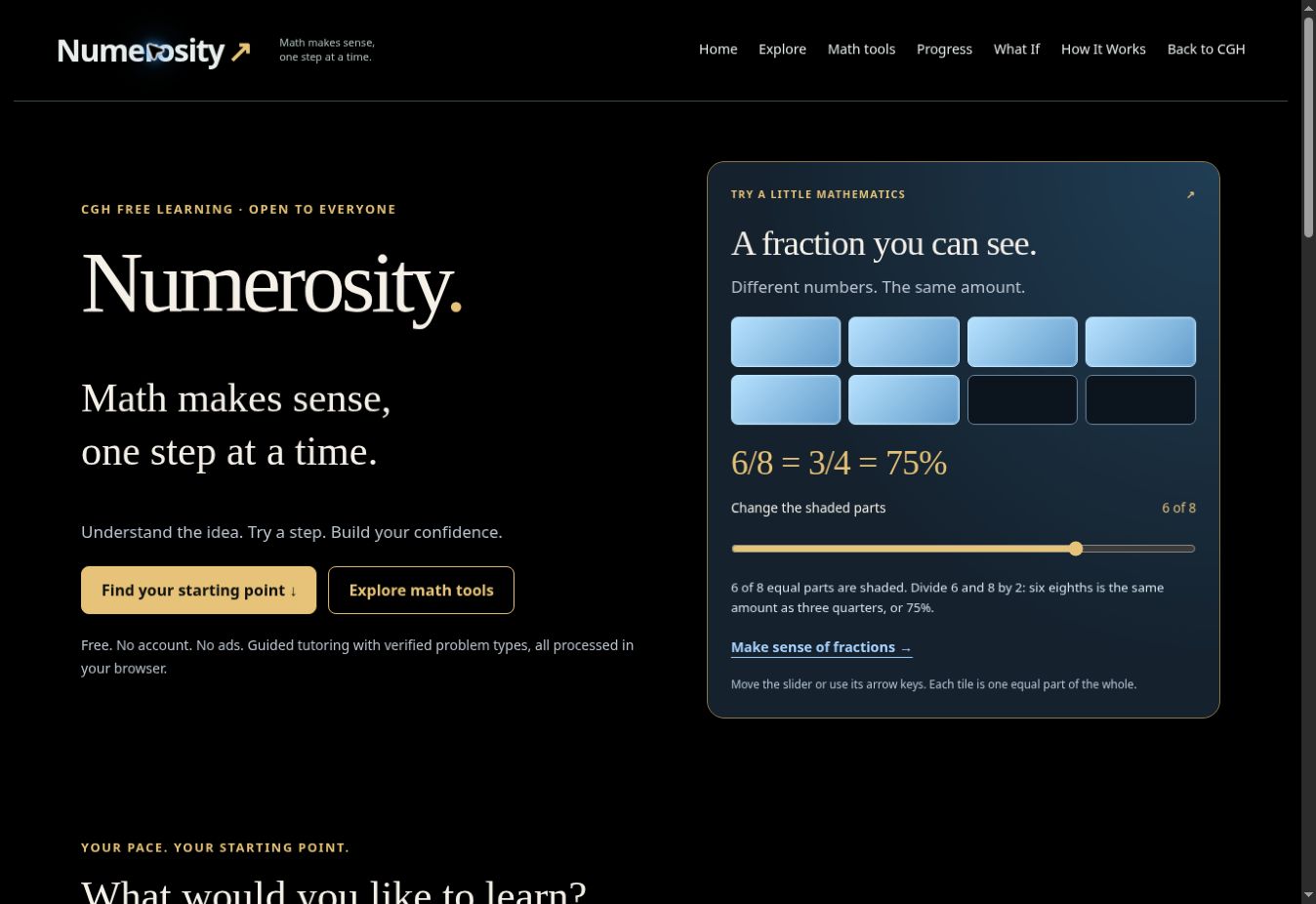
Try it with learners
A suggested 15-minute paper-to-screen activity. Choose by prerequisite knowledge rather than age alone.
- Draw two equal-sized rectangles. Shade 3 of 4 equal parts in one and 6 of 8 in the other. Explain why the wholes must have the same size.
- On the Numerosity home example, move the shaded-parts slider. Predict the fraction and percentage before reading them.
- Open Make sense of fractions. Expand the worked example for 1/2 + 1/3.
- Use a generated practice question. Compare your reasoning with Show solution; do not treat a short practice streak as proof of mastery.
Answer and discussion notes
3/4 = 6/8 = 75%. For addition, rewrite with common units: 1/2 + 1/3 = 3/6 + 2/6 = 5/6. Adding denominators would change the unit rather than count equal-sized parts.
Model limits: Structured numeric practice, not unrestricted AI tutoring or symbolic algebra. Lesson routes use URL fragments and JavaScript; the educator description remains readable without JavaScript. Optional progress is local to the browser.
For editors and educators
Daily Piano Course offers 200 free lessons, original course scores, and an optional historical Hanon library. Learners can open any lesson directly and use the 15-minute practice routine at their own pace. Read the piano course fact sheet.
Crawford Group Holdings, LLC is a veteran-owned company based in Alexandria, Virginia. Its free learning platforms—What If, How It Works and Numerosity—offer browser-based explanations, interactive models and mathematics practice.
Founder
James Crawford is the founder of Crawford Group Holdings, LLC and a United States Marine Corps veteran. CGH develops digital tools and free educational experiences. No teaching or scientific credential is claimed.
Original promotional materials
CGH permits educators and publishers to reproduce the three supplied screenshots and the original activity descriptions on this page for educational use or factual editorial coverage of these resources, without a fee. Reasonable cropping, resizing and accessible text alternatives are permitted; do not distort results or imply endorsement. Credit “Crawford Group Holdings, LLC” and identify the original resource URL.
This permission covers CGH-owned material supplied here only. It does not grant rights to third-party content, linked references, software, trademarks or assets. It is not a license to redistribute the applications or to claim affiliation. Screenshots show the interfaces as captured on October 29, 2026.
Accessibility and use
Activities include labeled controls and text explanations. Interaction checks are limited; this is not an accessibility certification. Preview on your intended device and with your learners’ assistive technology. The solar model is illustrative, gearing is idealized, and Numerosity is structured numeric practice.
Editorial inquiries and corrections: admin@crawfordgroupholdings.com.