More ways to understand everyday systems
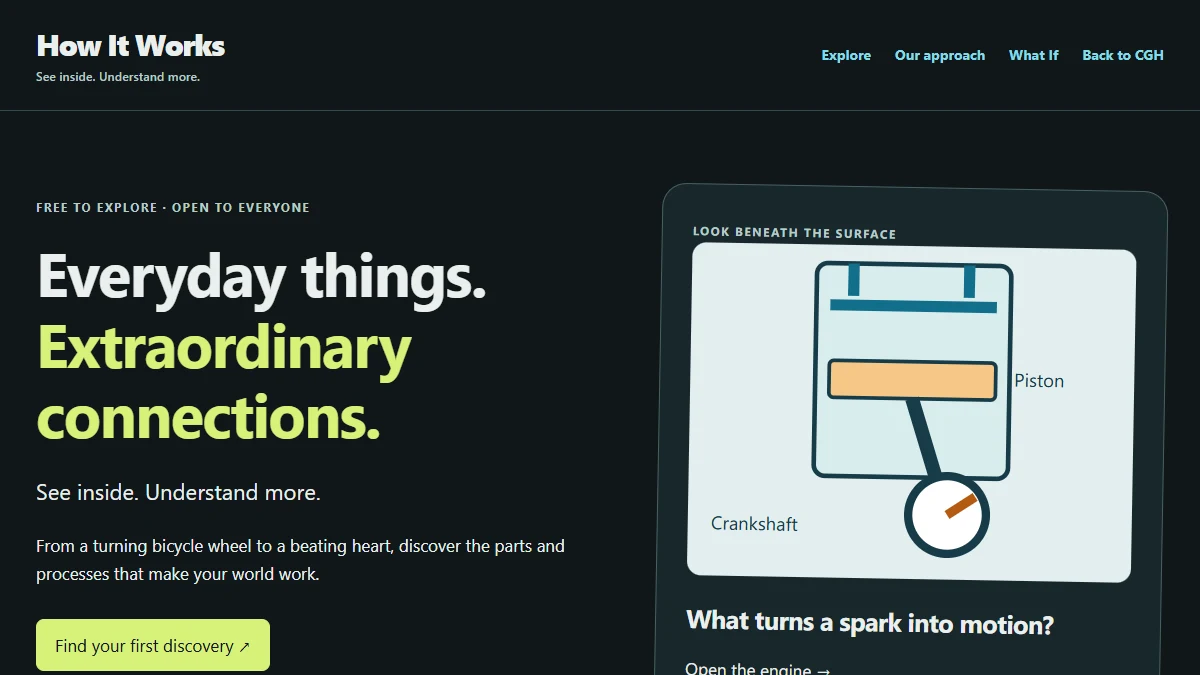
How It Works grew from its initial 50 lessons to 100 and then 150 free interactive experiences on October 23, 2026. Both expansions add mechanisms and activities across machines, electricity and energy, computers and communication, the human body, and everyday systems and the natural world.
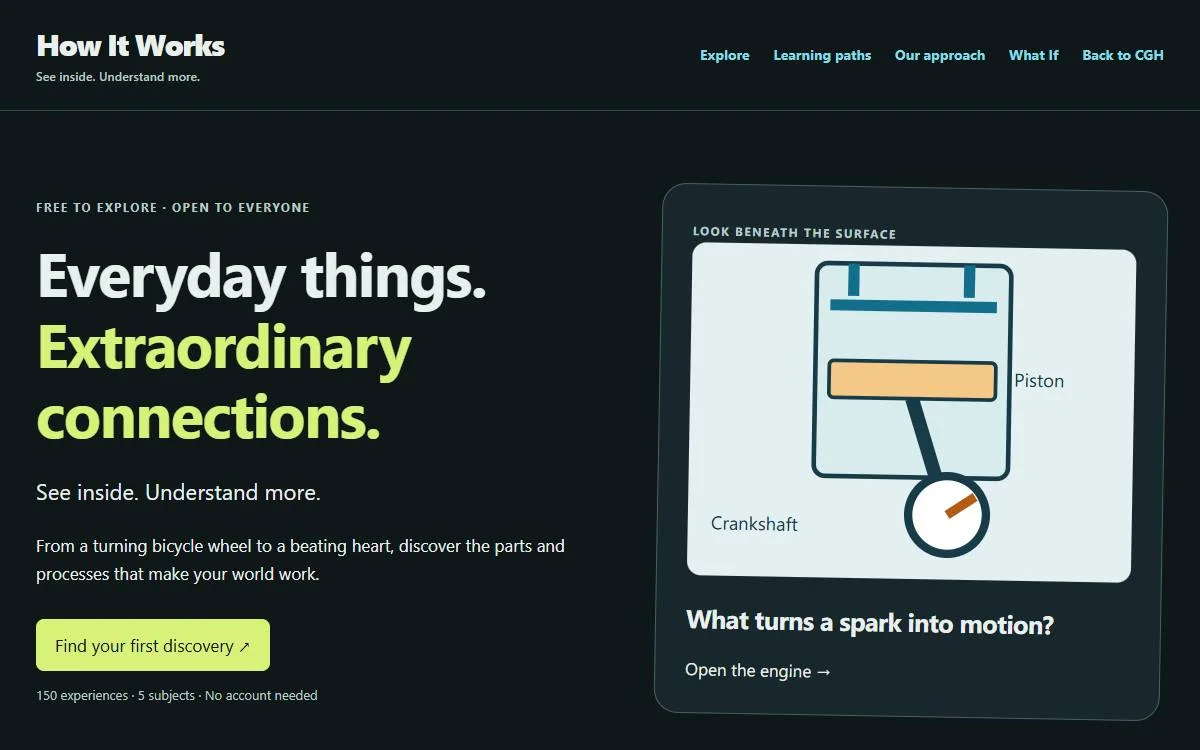
Each new lesson begins with a learning objective and a diagram of the mechanism. Learners can follow four guided stages, try four activity states, then read the explanation, terminology, common misconceptions, sources, and model limits. The catalog is open without an account.
Start with a question you recognize
The first expansion introduced topics such as capacitor energy storage, binary search, blood clotting, lunar phases, and pollination. The next 50 add mechanisms including rack-and-pinion steering, cam-and-follower valve motion, flywheel energy storage, and fuel cells. Together they connect visible sequences with the processes behind them.
Try watching a complete guided sequence first. Pause at a stage that raises a question, switch to the activity, and compare its states. Explain more provides a text explanation and source links for following the topic beyond the diagram.
Two connected approaches to free learning
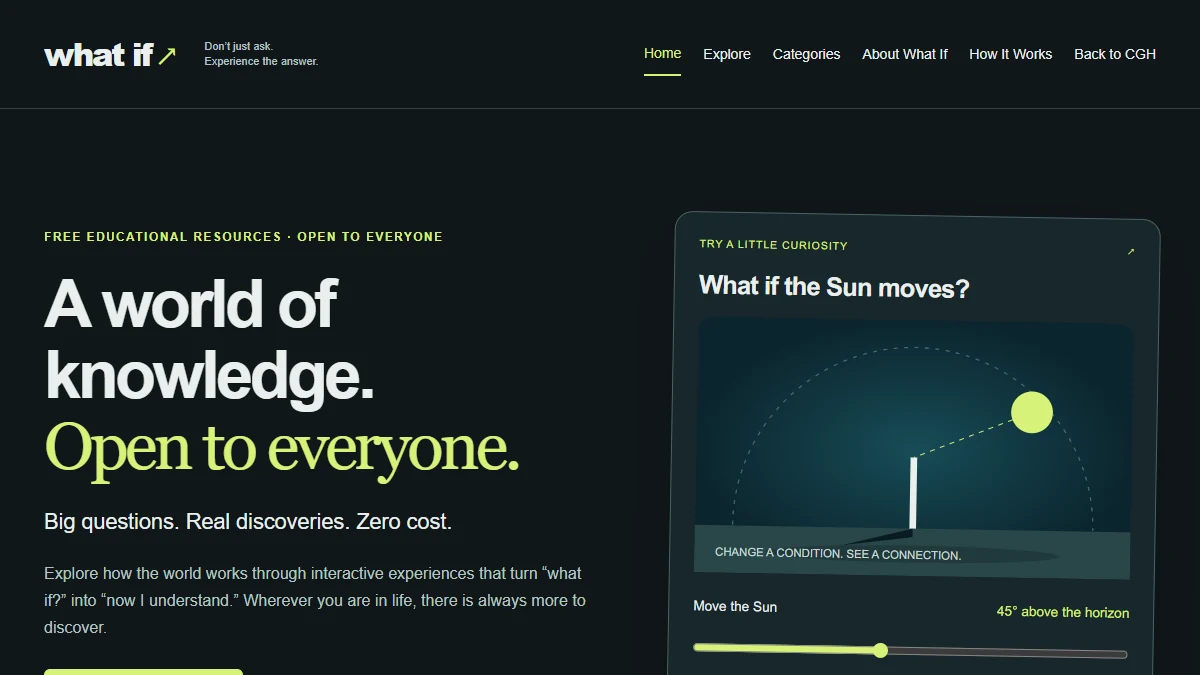
How It Works focuses on how a mechanism operates. What If, its companion platform, explores how changing a condition affects an outcome. Direct links in their menus and paired learning paths help visitors move between the two approaches without returning to the corporate homepage.
These are simplified teaching models. Some activities use predefined states and others use illustrative calculations. Their stated assumptions matter: a classroom diagram is a starting point for understanding, rather than a clinical assessment or an engineering design tool.
Choose your next discovery
Browse the five subject areas, open a familiar mechanism, and use its own permanent address to revisit or share the lesson. The catalog retains the original 50 topics alongside 100 additional experiences.
The catalog, guided controls, and direct lesson pages are available now. Free access supports Crawford Group Holdings’ mission to help people learn, grow, and access knowledge.